A stable scar is the starting requirement
Scar camouflage · Beverly Hills and Calabasas
Reduce the visible color contrast of a healed scar
Ruth Swissa assesses scar maturity, texture, location, surrounding skin, undertone, prior treatment, and medical context before discussing what customized pigment may realistically change.
 Scar camouflage · Beverly Hills and Calabasas
Deciding on scar camouflage
Address color contrast without promising texture change
Color matching happens on the skin
Evaluate camouflage after pigment settles
Scar and pigment review
Determine whether a healed scar is ready for camouflage
Ruth compares undertone and surrounding color in person and may build pigment through more than one session because scar tissue can respond differently.
Discuss options- 01A stable scar is the starting requirement
- 02Color matching happens on the skin
- 03Bring the scar’s medical and treatment history
- 04Evaluate camouflage after pigment settles
Scar camouflage begins with candidacy
Confirm that the tissue is stable before matching color
Scar type, age, texture, circulation, medical history, and remaining color contrast determine whether pigment may help. Camouflage can address color; it cannot flatten, fill, or medically change scar tissue.
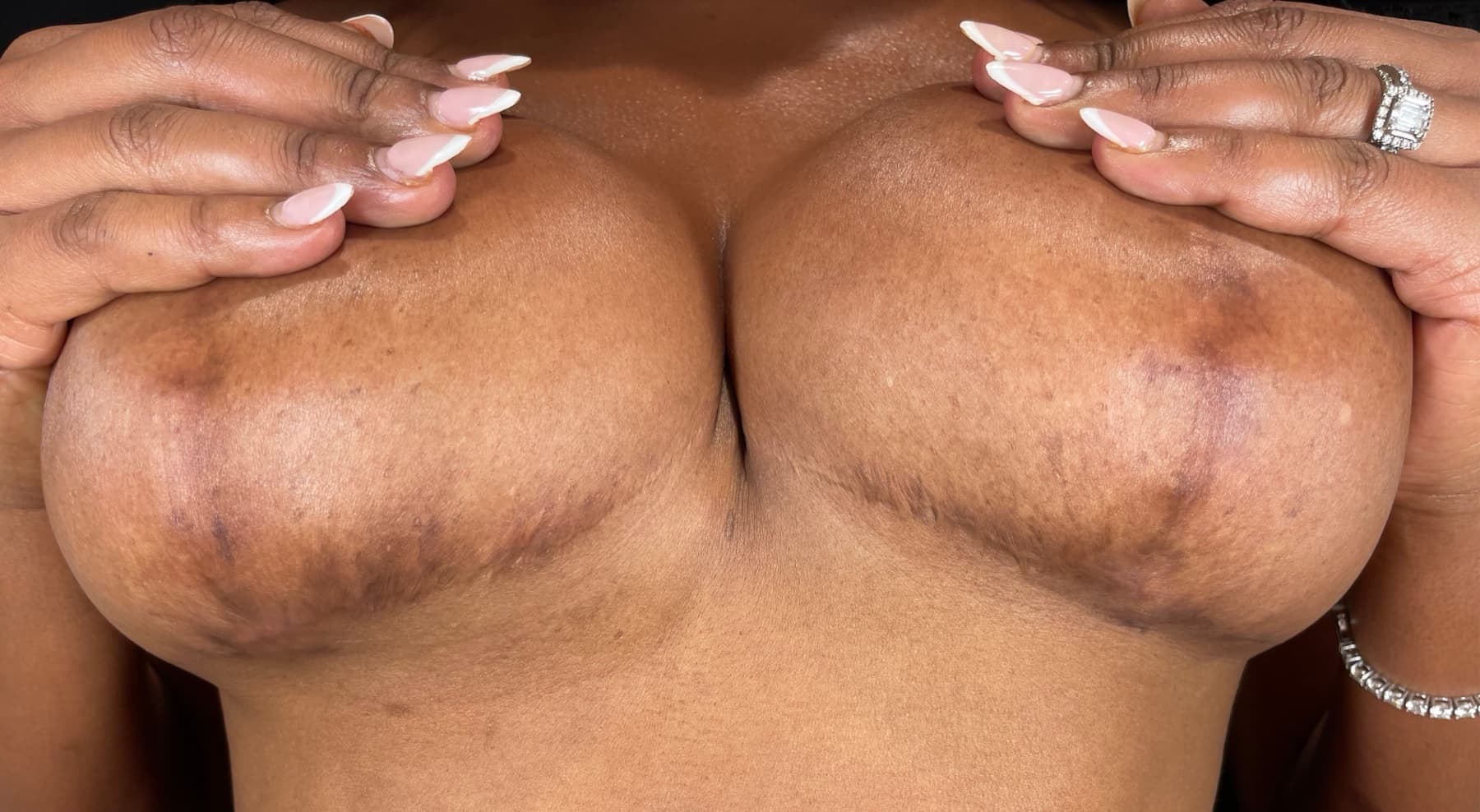
Before treatment — clinical image · 1 of 2
Scars we treat
Scars Ruth works with
Ruth works with many kinds of scars from surgery, injury, and medical treatment, as long as the scar is fully healed, no longer changing, and differs in color from the skin around it. If yours isn’t listed here, you’re still welcome to ask.
After surgery
- C-section scars
- Tummy tuck scars
- Breast augmentation scars
- Breast reduction and breast lift (“lollipop”) scars
- Gynecomastia surgery scars
- Breast implant removal scars
- Mastectomy and breast reconstruction scars
- Facelift scars
- Liposuction scars
- Thyroid and neck surgery scars
- Open-heart surgery scars
- Knee and hip replacement scars
After reconstruction or medical care
- Skin cancer surgery scars
- Nasal reconstruction scars
- Birthmark removal scars
- Cleft lip repair scars
- Skin graft scars
- Skin graft donor site scars
- Scalp surgery and hair transplant scars
After an injury
- Burn scars
- Dog bite scars
- Car accident scars
- Scars from cuts and stitches
- Sports injury scars
- Healed self-harm scars
Light or uneven color
- White or pale scars
- Flat, healed acne scars with uneven color
- Flat, light-colored stretch marks
- Reconstructed skin that doesn’t match nearby skin
- Stable birthmarks, after medical review
Pigment softens color, not texture: it doesn’t flatten raised scars, fill pitted or indented ones, or make a scar disappear. Keloids and scars that are still healing or changing aren’t candidates, and Ruth may ask for your doctor’s clearance first, especially after surgery, radiation, or reconstruction.
A stable scar is the starting requirement
Camouflage may suit selected fully healed scars with color differences. Pigment does not flatten raised tissue, fill depressions, or remove the scar itself.
Color matching happens on the skin
Ruth compares undertone and surrounding color in person and may build pigment through more than one session because scar tissue can respond differently.
Bring the scar’s medical and treatment history
Discuss age, procedures, healing complications, symptoms, medications, allergies, prior camouflage, sun exposure, and any clinician guidance relevant to the tissue.
Evaluate camouflage after pigment settles
Treated color shifts while healing, and the surrounding skin can change with sun and time. Further work is based on the healed contrast, not a promise of invisibility.
Individual experiences
Burn recovery and scar camouflage stories
Hear personal experiences and view treatment footage connected with burn-survivor care. Every scar and healing history is different, so these stories are not a promise of outcome.
Further reading and options
Before scar camouflage
Questions about tissue stability, color matching, healing, and limits
01What can scar camouflage change, and what can’t it?+
Camouflage may reduce visible color contrast in selected fully healed scars. Pigment changes color only: it does not flatten a raised scar, fill an indented one, or remove the scar itself, so any altered texture remains.
02When is a scar mature enough for camouflage?+
The scar should be fully healed and stable before pigment is considered. Timing varies from scar to scar, and medical clearance may be appropriate after surgery or complicated healing.
03What history should I share before scar camouflage?+
Discuss the scar’s age, procedures, healing complications, symptoms, medications, allergies, prior camouflage, sun exposure, and any clinician guidance relevant to the tissue.
04Will the pigment match my surrounding skin?+
Ruth customizes the color match, but treated color shifts while it heals, and the surrounding skin and the pigment can change differently with sun, seasons, and time. No exact or permanent match can be promised, so any further work is based on the healed contrast rather than a promise of invisibility.
05Can scar camouflage address a scar after breast augmentation?+
A selected incision scar may be considered after your surgeon confirms the tissue is fully healed and stable. Pigment may reduce color contrast; it cannot change an implant concern, breast shape, pain, infection, or raised or indented texture.
06Can pigment camouflage an acne scar?+
Only selected, fully healed acne scars with stable color contrast may be considered. Pigment can adjust color; it cannot flatten a raised scar, fill a depression, smooth pitted texture, treat active acne, or stop new breakouts. Active lesions, inflammation, unexplained change, or recent procedures need appropriate medical or dermatologic evaluation first.
Consultation for scar camouflage
Bring your scar camouflage questions to Ruth Swissa
Ruth Swissa assesses scar maturity, texture, location, surrounding skin, undertone, prior treatment, and medical context before discussing what customized pigment may realistically change.
Request consult